
Understanding Annotator Safety Policy with Interpretability





Published at
FAccT
2026
Abstract
Safety policies define what constitutes safe and unsafe AI outputs, guiding
data annotation and model development. However, annotation disagreement is
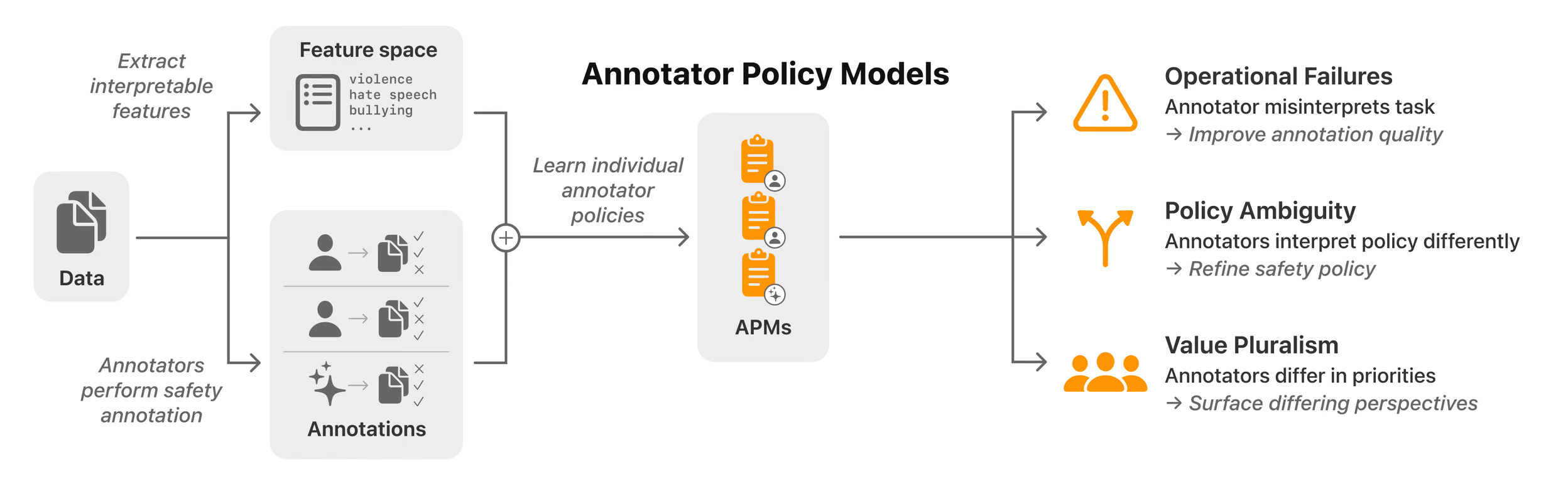
pervasive and can stem from multiple sources such as operational failures
(annotators misunderstand or misexecute the task), policy ambiguity (policy
wording leaves room for interpretation), or value pluralism (different
annotators hold different perspectives on safety). Distinguishing these sources
matters. For example, operational failures call for quality control, ambiguity
calls for policy clarification, and pluralism calls for deliberation about
incorporating diverse perspectives. Yet understanding why annotators disagree
is difficult. Directly asking annotators for their reasoning is costly,
substantially increasing annotation burden, and can be unreliable for both
human and LLM annotators as self-reported reasoning often fails to reflect
actual decision processes. We introduce Annotator Policy Models (APMs),
interpretable models that learn annotators' internal safety policies from
labeling behavior alone, making annotator reasoning visible and comparable
without additional annotation effort. We validate that APMs accurately model
annotator safety policy (>80% accuracy), faithfully predict responses to
counterfactual edits, and recover known policy differences in controlled
settings. Applying APMs to LLM and human annotations, we demonstrate two core
applications: (1) surfacing policy ambiguity by revealing how annotators
interpret safety instructions differently, and (2) surfacing value pluralism by
uncovering systematic differences in safety priorities across demographic
groups. Together, these capabilities support more targeted, transparent, and
inclusive safety policy design.